
What Causes Motion?
- Motion is caused due to force.
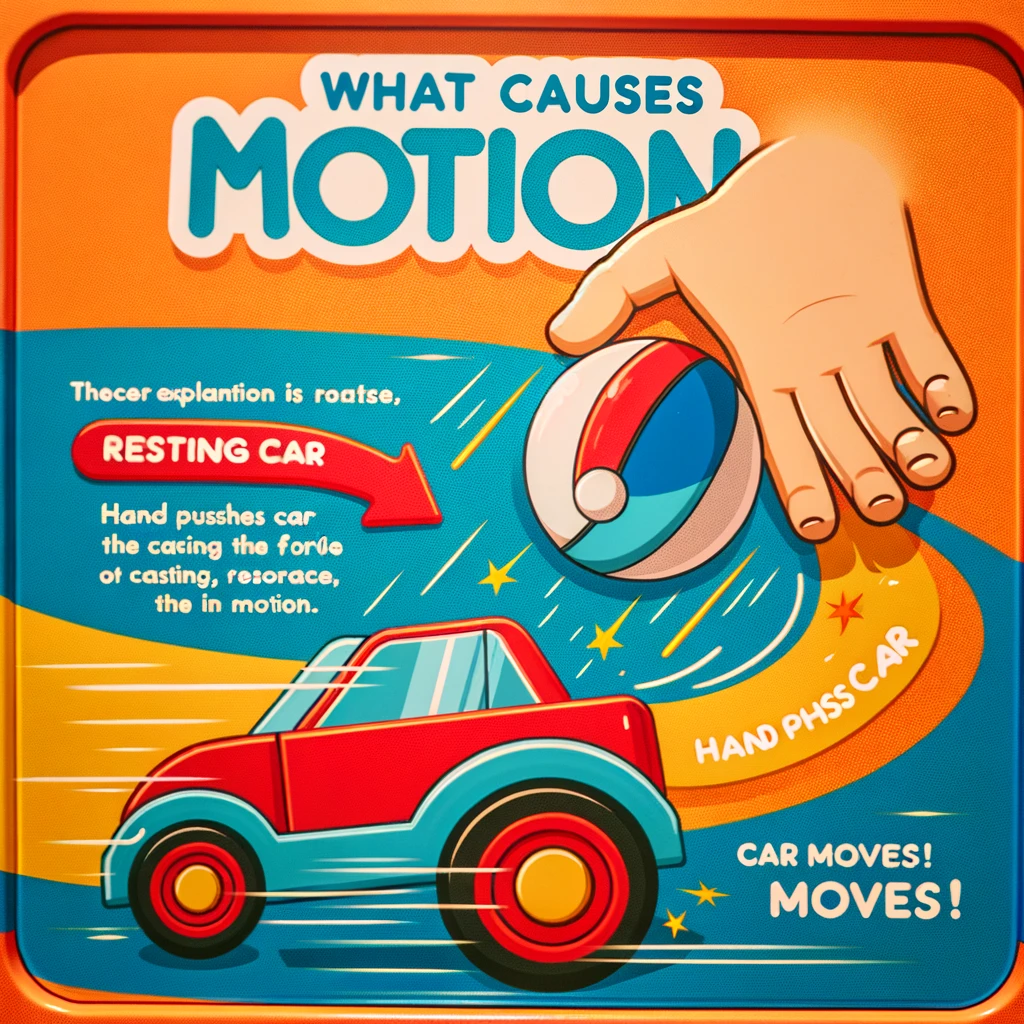
A force can bring a resting body into motion, bring a moving body to rest, speed up or slow down a body, change the direction of a body, and change the shape or size of a body.
Concept of force
- The SI unit of force is the Newton (N).
- Forces can be balanced (net force = 0, no acceleration) or unbalanced (net force ≠ 0, causes acceleration).
- Forces can be contact (e.g., frictional force) or non-contact (e.g., gravitational force).
- Forces can be conservative (work done is independent of the path) or non-conservative (work done depends on the path).
Laws of Motion:
- First Law of Motion (Inertia): An object remains at rest or in motion at a constant velocity unless acted upon by an external force.
- Example: A person sitting in a moving car is pushed forward when the car stops abruptly.
- Second Law of Motion (Momentum): The rate of change of momentum is proportional to the applied force and occurs in the direction of the force.
- Example: A truck has more momentum than a bullet bike if its mass is greater than the bike’s velocity.
Relate all the examples from the picture
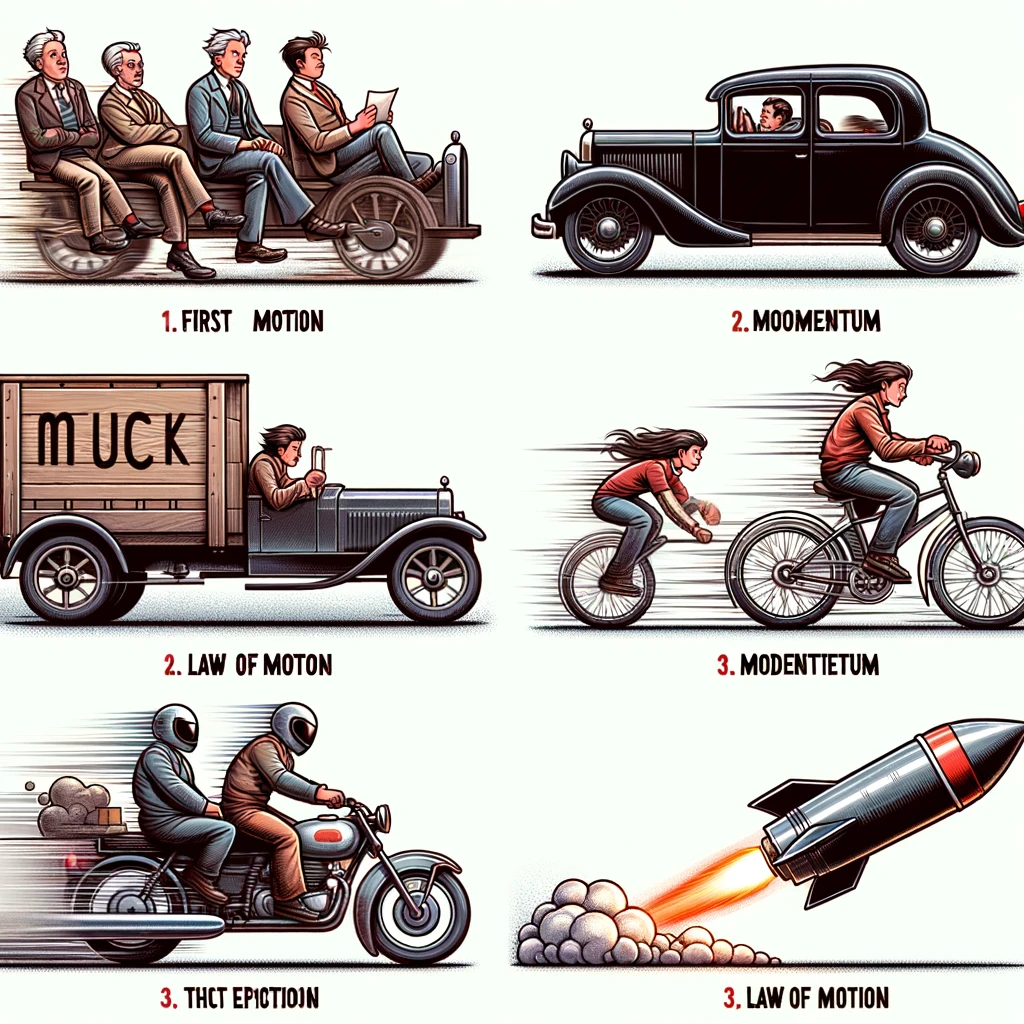
Third Law of Motion: For every action, there is an equal and opposite reaction.
- Example: A rocket expels gas downwards, and as a reaction, it moves upwards.
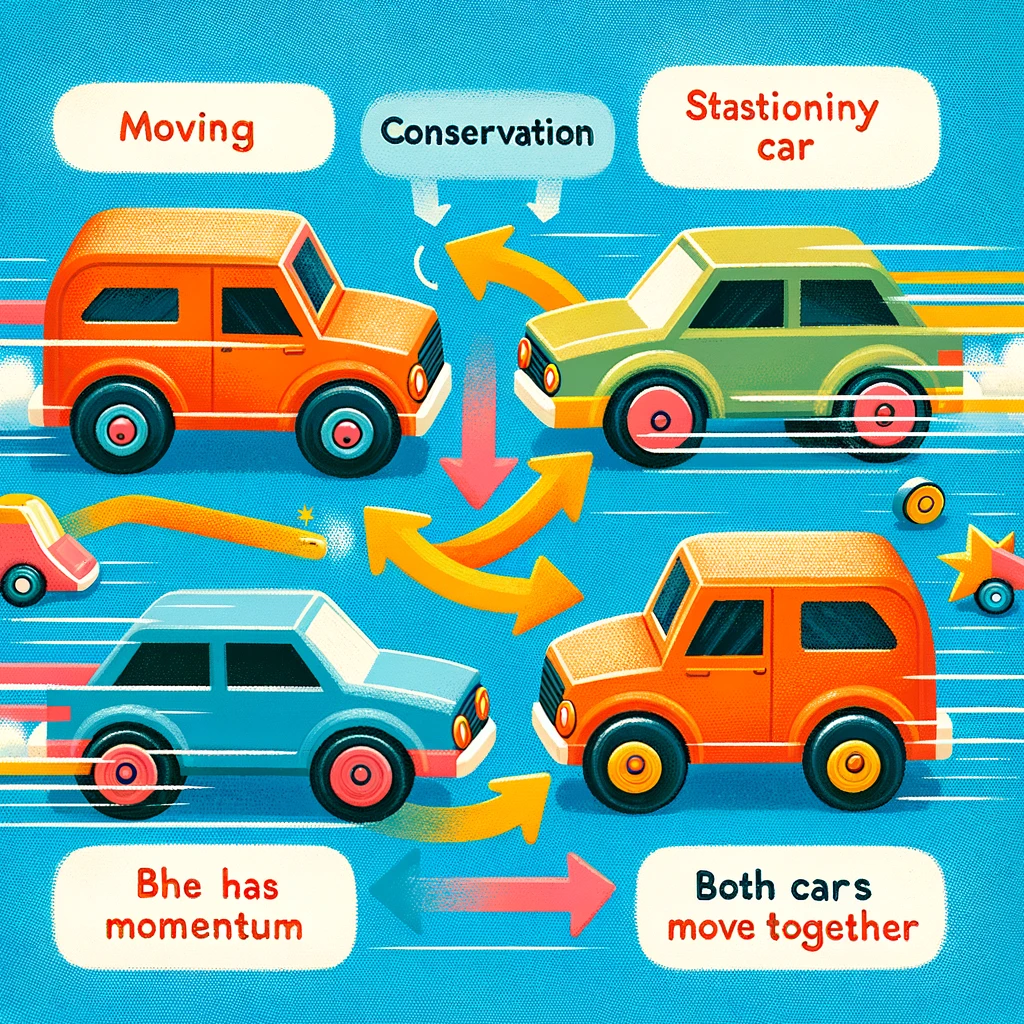
Conservation of Momentum:
- The total momentum before and after a collision is conserved.
Example: If a moving object collides with a stationary object, the total momentum before and after the collision remains the same.
One-liners (MCQs):
- The range of weak nuclear force is of the order of 10^-18 m.
- The force of friction always opposes the applied forces.
- The force of the Earth’s gravity on every kilogram is about 10 N.
- Gravitational force is an example of an “action at a distance” force.
- Once a satellite is launched into orbit, the only force governing its motion is the force of gravity.
- The SI unit of Electrostatic force is Coulomb (C).
- Torque is the measure of force that can cause an object to rotate about an axis.